

A bizarrely eloquent briefing note
This is the 329th edition of SHuSH, the newsletter of The Sutherland House Inc. If you’re new here, press the button—it’s free:
Sutherland House is always happy to receive submissions of manuscripts or proposals for nonfiction books. If you are looking to get published, contact submissions@sutherlandhousebooks.com. Agents welcome, but no agent required.

Pretend you are Marc Miller.
Pretend you are a boyhood chum of Justin Trudeau who studied political science and law and was elected to office as a Liberal member of parliament in 2015.
Last December, you were appointed minister of identity and culture by your old pal’s successor, Prime Minister Mark Carney. It’s your fourth minor portfolio in five years. You’ve barely found your new office when you’re hit by a spate of news stories about the plight of the English-Canadian book industry. So you sensibly request of your new staff a “breakdown of Canadian and foreign-owned book publishers in the anglophone and francophone markets in Canada.”
What would you be looking to learn from the briefing document you’ve requested? If I were on your staff, I’d assume the following:
You want to know how much of the business is owned by Canadians, English and French, and how much is owned by foreigners, and you want to know the relative performance of each. You’ll be interested in how Canadians are faring against foreign competition and if domestic firms are doing better or worse over time, and whether there’s any cause for alarm on either the English or French side.
You’ve been several months on the job so we’ll presume by now you’re aware that for decades it has been federal policy to encourage a Canadian-owned publishing sector, and that a regime of ownership restrictions, grants, tax measures, export assistance, and other cultural programs has been designed to pursue that goal. So you’ll expect the briefing document to tell you if all these policies and programs are working. Has federal policy lived up to its promises to Canadians about their book industry?
We’ll guess that as the son of Carman Miller (McGill historian and author of a capable biography of Frederick Borden) and Pamela Miller (former history of medicine librarian at McGill’s Osler Library) you’ll appreciate that the larger purpose of all your department’s policies and programs is to ensure Canadians can produce and circulate their own ideas, tell their own stories. So you’ll want to know if all this activity is not merely subsidizing the production of books but sustaining the cultural and intellectual life of the country.
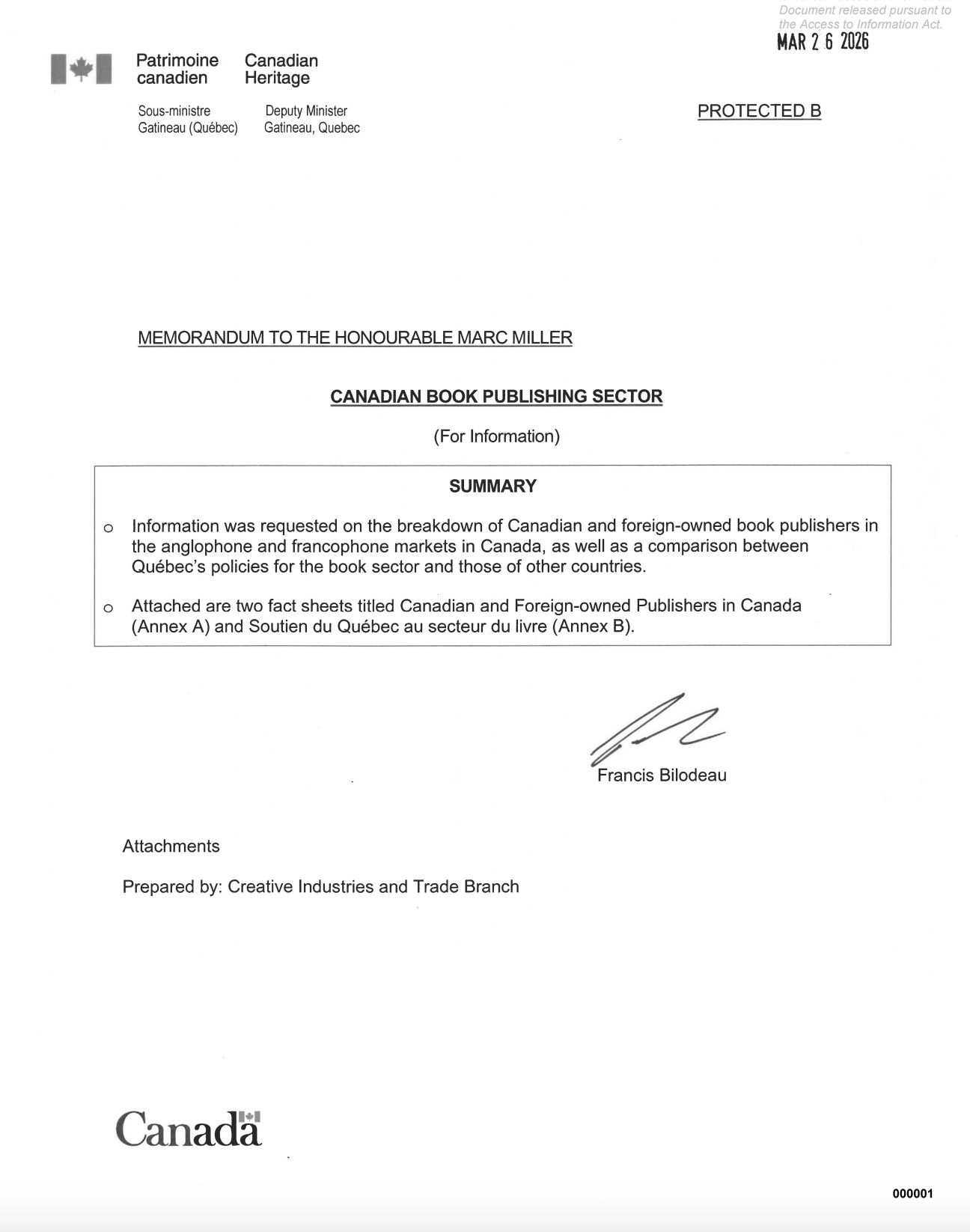
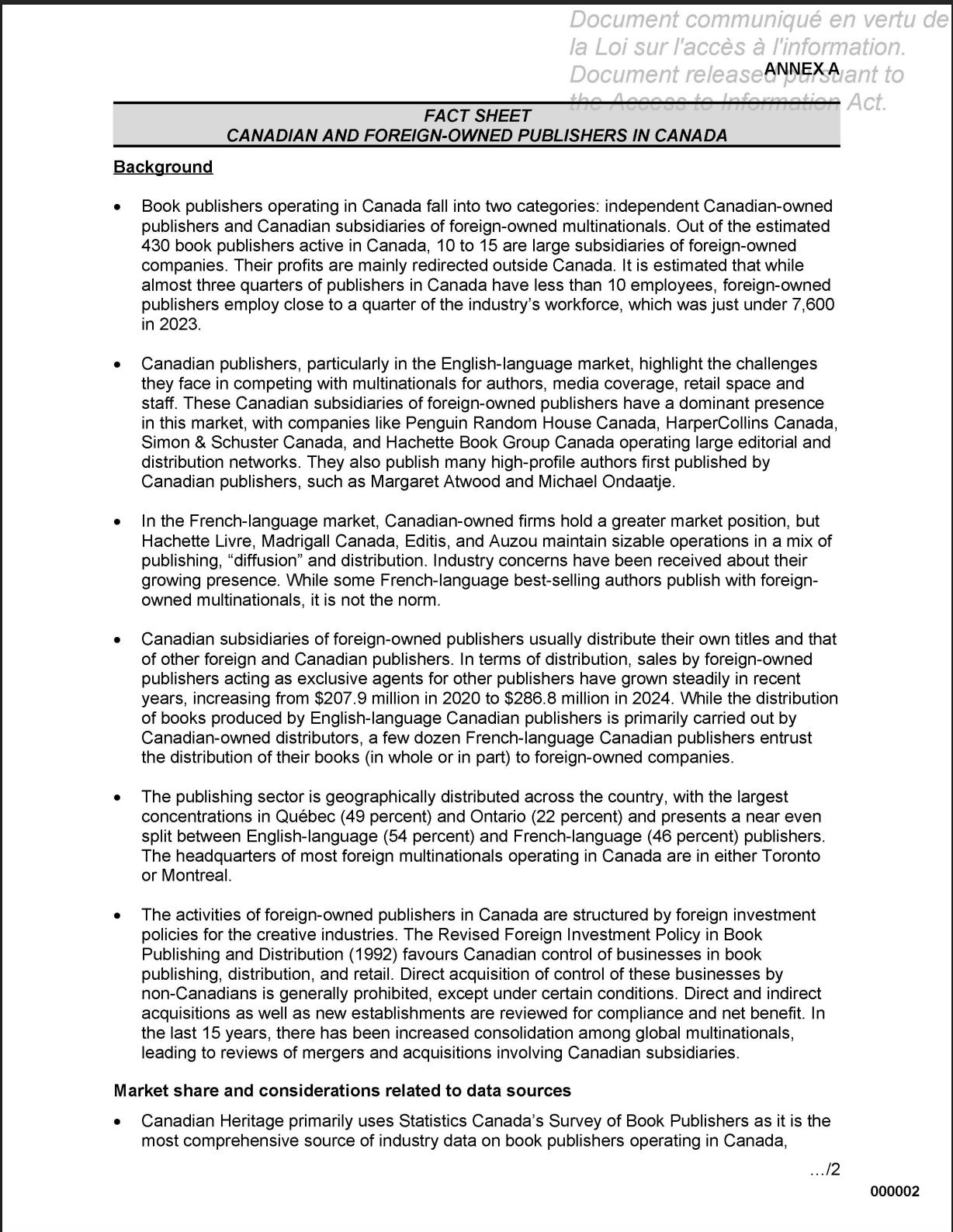
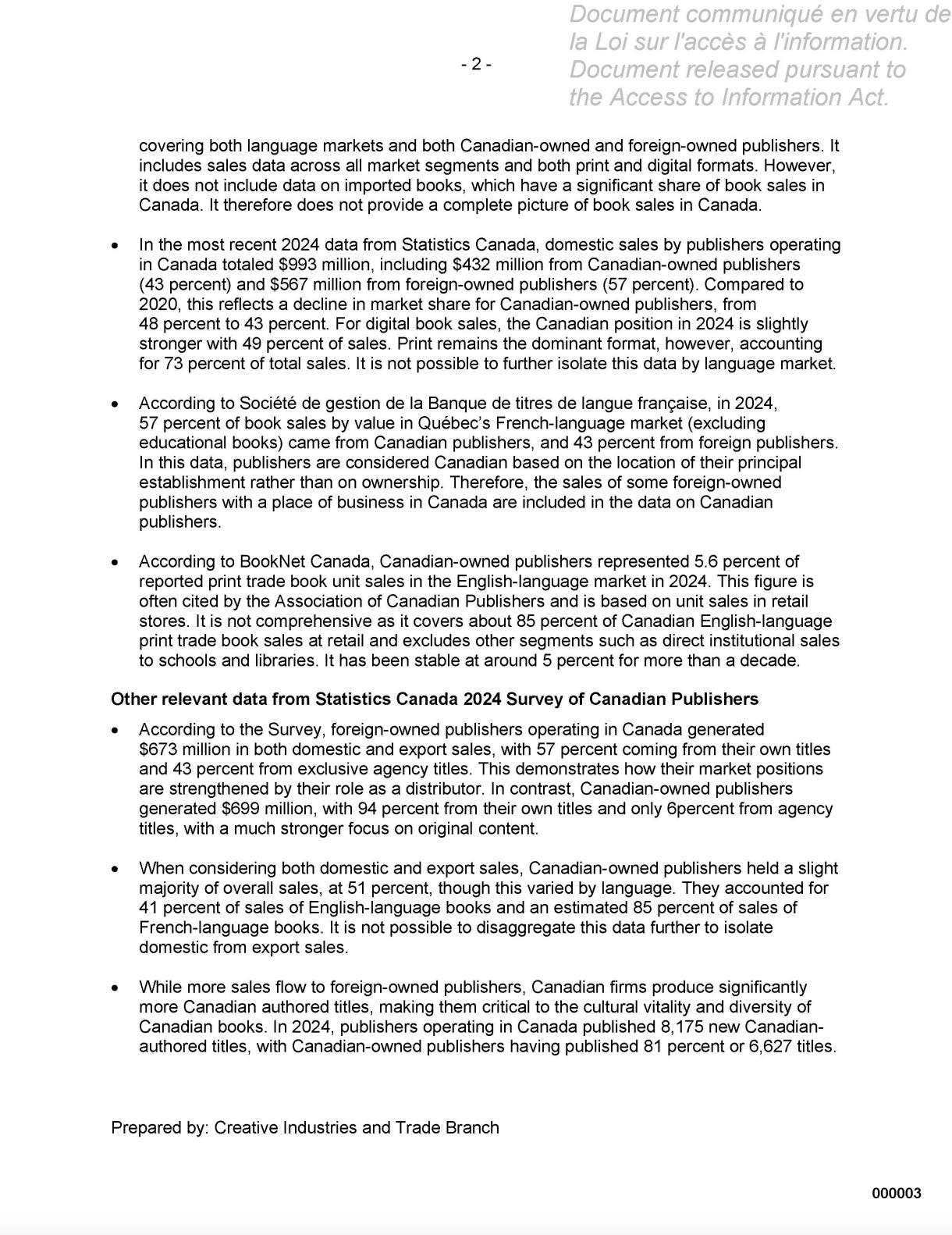
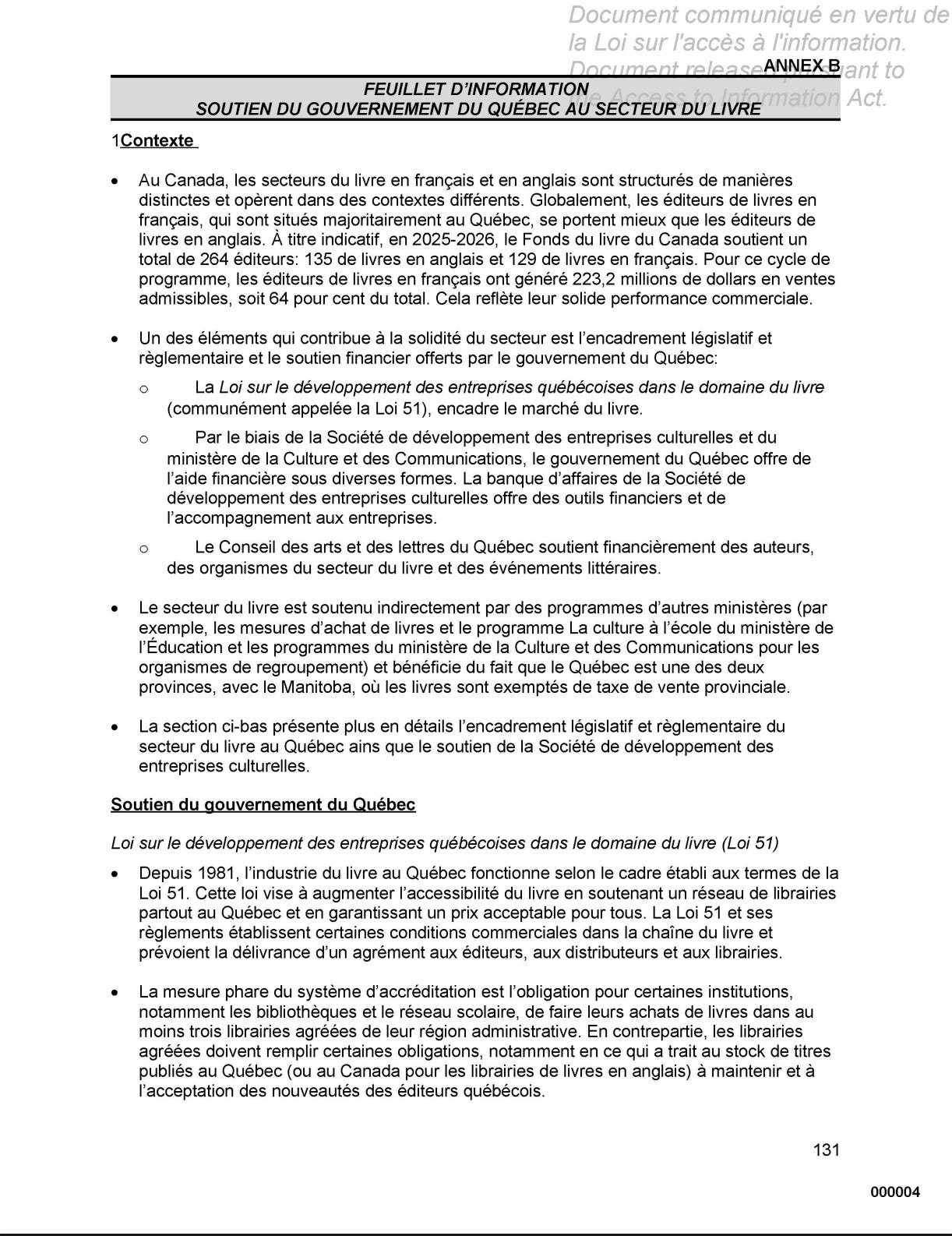
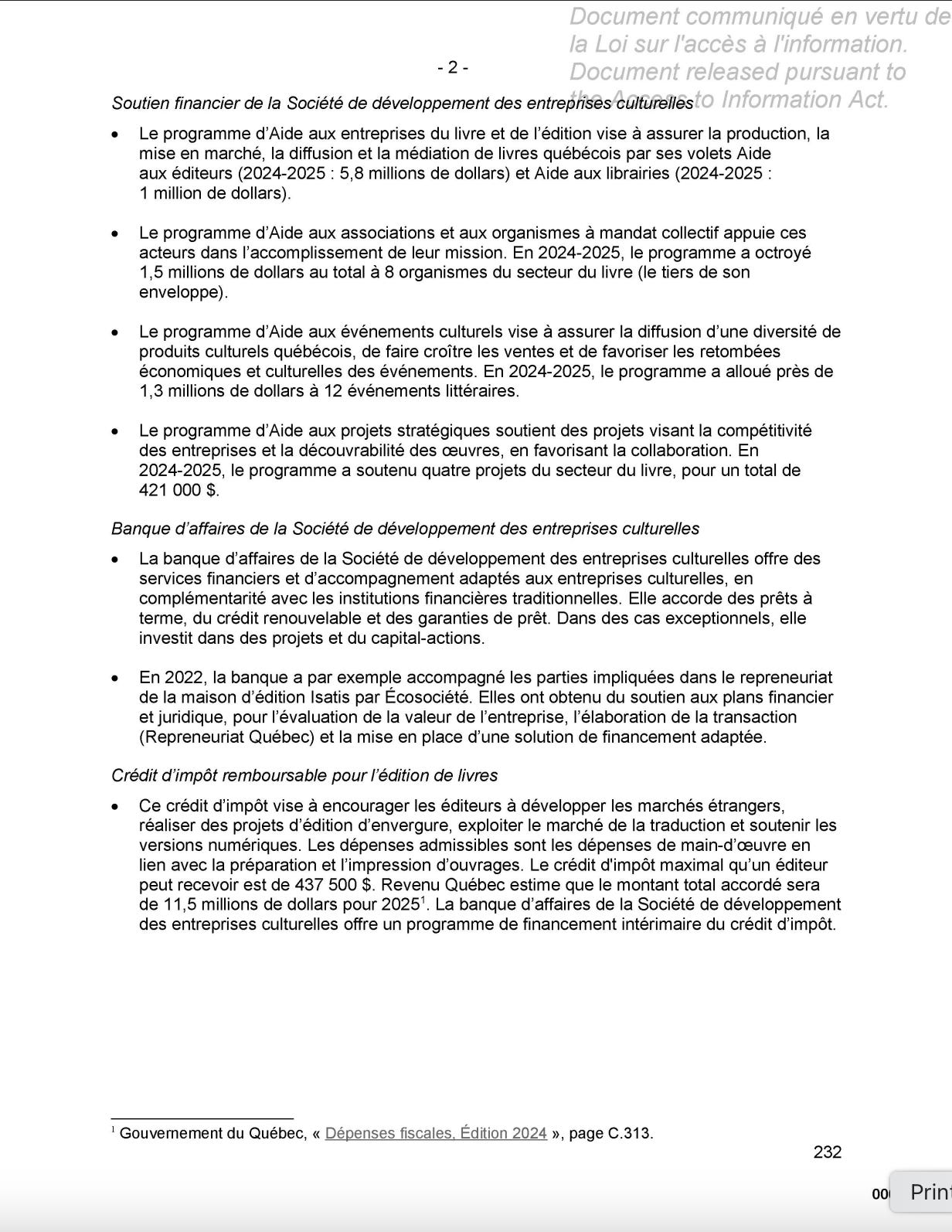
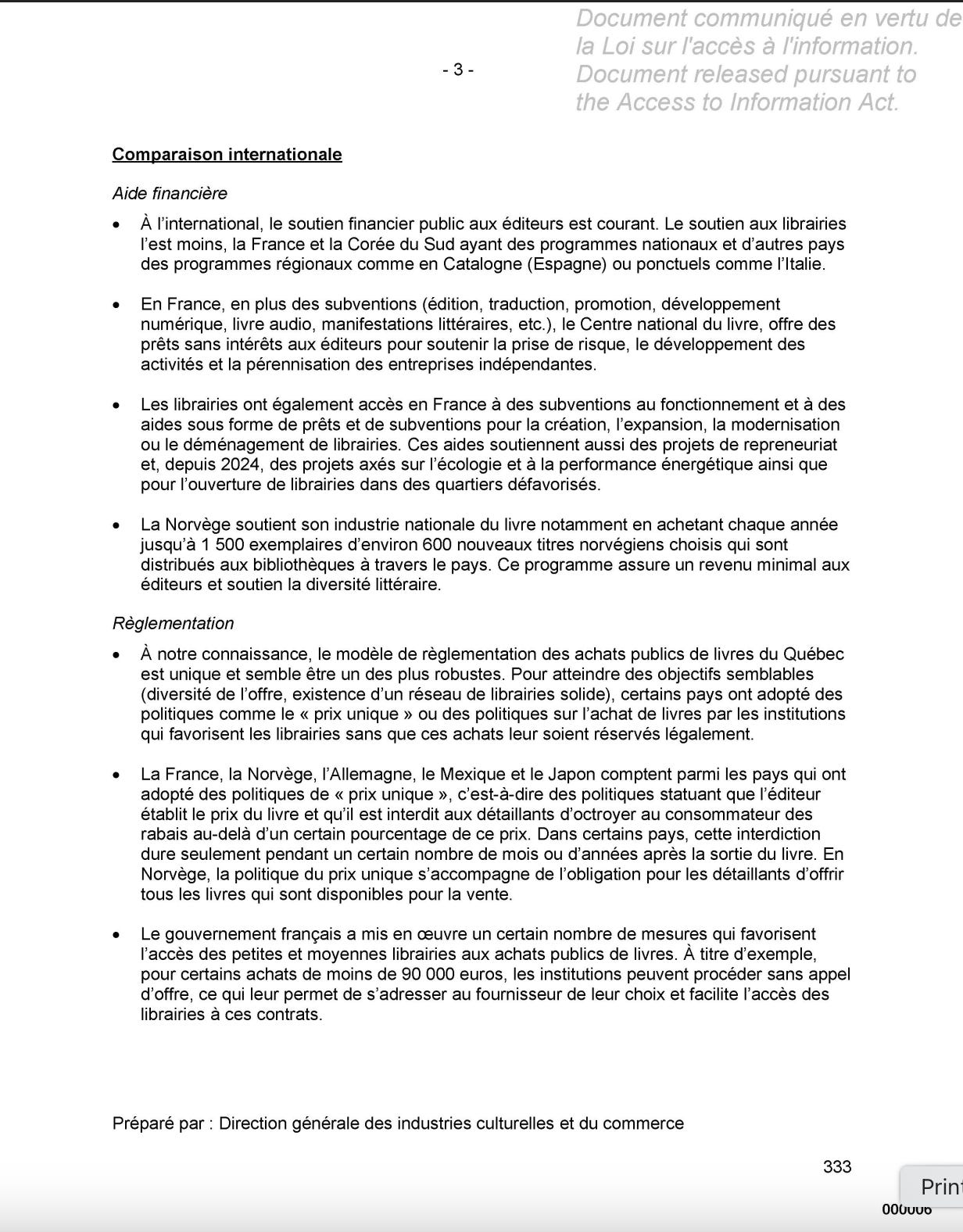
I’m going to reproduce below the whole of the briefing note that was delivered to Minister Miller on March 26, 2026. A friend stumbled upon it in the course of an access to information request. You can make up your own minds as to whether Miller’s staff did an adequate job of breaking down the state of the Canadian book industry. But, first, my impressions of the briefing.
Mostly, it’s a bag of mismatched facts that fail to adequately answer any of the above questions. You get a general sense that the multinationals are doing better than the French-language Canadian-owned publishers who are doing better than the English-language Canadian-owned publishers. That’s about it.
The note pulls from three incompatible data sets, each of which measures different things using different methodologies. One reports revenue, another unit sales, and another excludes educational publishing. There are large numbers thrown around—domestic sales by publishers operating in Canada are $993 million, and 57 percent of that goes to the multinationals. But how is the remaining 43 percent split between Canadian-owned French and Canadian-owned English publishers? Doesn’t say, and can’t be determined from the jumble of data. Some StatsCan numbers are featured without reckoning with the agency’s broad definition of the book industry, including educational, professional, technical, scholarly, reference, children's, travel, atlases, and trade books. It’s hard to believe a deputy minister signed off on this presentation.
Nor is the minister given a clear picture of how foreign firms operate in Canada. There are three major players: Penguin Random House Canada, HarperCollins Canada, and Simon & Schuster Canada. Miller is told that the multinationals are dominant in Canada and that they generate hundreds of millions in revenue, much of it from what the briefing calls their “own titles.”
That makes it sound like the multinationals are simply very large Canadian publishers. They are not, and that characterization obscures the defining feature of our competitive market.
The multinationals produce relatively modest slates of Canadian-authored books. Most of their Canadian business consists of monetizing “owned titles” created and financed elsewhere in their global organizations. They publish Canadian editions of successful US and UK books, or simply import those books directly into Canada. It is a comparatively low-risk, high-margin business, and, as best I can determine, it accounts for well over three-quarters of their Canadian revenue.
The profits from this imported business—trucking in pallets of Colleen Hoover and James Patterson—finance the modest Canadian-authored publishing programs of the Big Three. Because those programs represent only a small part of their Canadian operations, they can bid aggressively for the most commercially promising books by Canadian authors. In doing so, they establish a high market price for Canadian publishing rights and monopolize the most marketable writers in Canada. Canadian-owned publishers, whose entire business depends on earning a return from Canadian books, can’t compete. So decade by decade, the multinationals grow more dominant in the Canadian market and Canadian-owned players are pushed to the margins.
Let me dwell on this dynamic for a moment because no one in Ottawa seems to appreciate it. Multinationals are exploiting foreign intellectual property in Canada, inflating book acquisition costs and transferring an increasing share of Canada's most valuable publishing assets to their foreign-owned selves, undermining Canadian-owned publishers along the way. It might have been helpful for the minister to see that clearly.
Almost as an afterthought, the note allows that Canadian-owned English-language publishers cite data showing that they represent just 5.6 percent of print trade book unit sales in their own market—again, the multinationals are dominant. The claim that Canadian-owned English-language publishers appear to be insignificant in their home market would seem to be worth pursuing. Instead, the note suggests, on the one hand, that the data is incomplete—now we care about the quality of data—and on the other hand nothing to worry about because “it has been stable at around 5 percent for more than a decade.” Interesting word choice: “stable” over, say, disgraceful, disastrous, alarming. The minister is never told that back when he was a law student, Canadian-owned English-language publishers represented 20 to 25 percent of their home market.
This leads us to Question 2. Are all the government’s policies and programs doing a good job of encouraging a Canadian-owned publishing sector? The briefing note implies that it is, pointing to “The Revised Foreign Investment Policy in Book Publishing and Distribution (1992) favours Canadian control of businesses in book publishing, distribution, and retail,” and that “direct acquisition of control of these businesses by non-Canadians is generally prohibited,” and that “new establishments are reviewed for compliance and net benefit.” The minister is told not only that the policy exists, but that there have been many reviews.
What the minister is not told is that in the last quarter century foreign investment has run rampant in the Canadian book sector. American-owned Amazon was allowed to walk in and become the country’s leading book retailer. Simon & Schuster was allowed to open a publishing program in Canada despite not being Canadian-owned. McClelland & Stewart, the crown jewel of Canadian-owned publishing, was acquired by Penguin Random House Canada, a deal that certainly didn’t favour Canadian control.
Let’s add this up. The briefing note fails to tell the minister that successive governments have allowed massive breaches of its ballyhooed Revised Foreign Investment Policy in Book Publishing and Distribution, undermining its Canadian-ownership goals. It also fails to mention that the same policy regime has allowed foreign-owned publishers to generate substantial profits by exploiting foreign intellectual property in Canada and use those profits to out-compete and occasionally acquire Canadian-owned publishing operations.
You would think the minister might want to know that government inaction and the structural inequities of the industry are feeding Canadian publishing to foreign-owned companies.
On Question 3—are policies and programs ensuring Canadians can produce and circulate their own ideas and tell their own stories?—the briefing note is silent.
This is shocking. Sustaining the intellectual and cultural life of the country is the point of the exercise—more important even than ensuring Canadian ownership, especially with our political and cultural sovereignty in jeopardy. The briefing document is uninterested.
Where does that leave us?
We should count ourselves lucky that Minister Marc Miller made a reasonable request to be briefed on the English-Canadian book sector. Book publishing is one small corner of his portfolio, alongside film, television, performing arts, festivals, museums and preservation, galleries, multiculturalism, cultural trade, monarchy and the Crown, languages, celebrations and commemorations, anthems, human rights, and sports. He’s going to be a very busy man with all these files, his role in cabinet and the government, and his work as a member of parliament. He’s already halfway through what likely will be a brief tenure in the Department of Identity and Culture (it’s had a new minister every twenty months for twenty years). And ministers in Canadian cabinets are seldom free to address issues on their own—they take direction from the prime minister’s office. So it’s something of a miracle that he noticed and asked a perfectly reasonable question about us.
The briefing note, from that perspective, is a huge disappointment. Little can be learned from the random assortment of information it offers. A prime opportunity to alert the minister to serious problems in the book publishing sector has been lost.
From another angle, however, the briefing note is staggeringly eloquent. Just not about our industry. What it powerfully and persuasively communicates is that the minister’s department is incapable of mustering the data and analysis to answer the most basic questions about what’s happening in book publishing.
That might not seem like a big deal—the minister has a broad portfolio—but more than half a century ago the federal government assigned itself the mandate to develop the Canadian book publishing sector. Its policies and programs spurred a good deal of publishing activity. They shaped the book market in Canada, wrote the rules for authors and publishers, and altered the incentives that drive investment. All this has given the Department of Identity and Culture a domineering presence in our industry. It has made our industry, particularly its English-language component, almost a ward of the state. Somewhere along the way Minister Miller’s department either lost interest in its ward, or lost its capacity for governance. The briefing note couldn’t be clearer that it’s clueless about what’s happening in our industry. Nor can it be bothered to figure it out, even when asked by the boss.
That’s where we’re left. The policies are still in place, but routinely breached. The programs are still paying out, but shrinking by the year. The real world of book publishing is obscure to those responsible for it. No one is asking if the government’s objectives are being met. No one in a position of authority has the information to make that determination.
We often wonder here why there’s no sense of urgency to help the English-Canadian book industry, and why no one in Ottawa feels accountable for the mess that’s been made of it. This briefing note is the answer.
Now here from Sutherland Quarterly
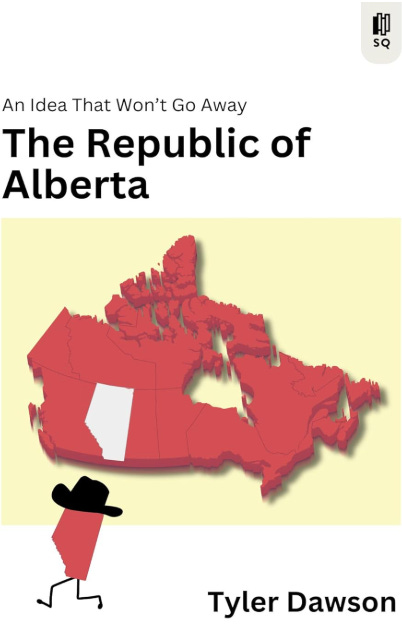
Sutherland Quarterly is pleased to announce its latest edition, Tyler Dawson’s exceptionally timely The Republic of Alberta: An Idea that Won’t Go Away:
What could the consequences be if Alberta turned its back on Canada?
In The Republic of Alberta, Globe and Mail journalist Tyler Dawson delivers the definitive history and analysis of Alberta’s long-simmering separatist movement. From its colonial roots and early resentment toward Ottawa, through the oil-fuelled grievances of the NEP era, to the rise of modern populism and convoy protests, Dawson charts a clear trajectory of Western alienation. Blending historical insight with contemporary reporting, he examines the thinkers, politicians, and cultural flashpoints that have shaped the separatist impulse. As Alberta Premier Danielle Smith courts separatist sentiment more openly than her predecessors, Dawson explores the uncertain future of a province increasingly questioning its place in Canada.
Buy your copy now or take advantage of this special offer for SHuSH subscribers: buy a subscription to Sutherland Quarterly (or treat a friend) and we’ll send you the Sutherland House book of your choice at no charge.
Launched in 2022, Sutherland Quarterly is an exciting new series of captivating essays on current affairs by some of Canada’s finest writers, published individually as books and also available by annual subscription—four great books a year, mailed to your door, for just $67.99. Subscribe now at sutherlandquarterly.com and we’ll immediately be in touch to send you the free book of your choice.
Thanks for reading. Please either:
Our Newsletter Roll (suggestions welcome)
Ian Coutts’ New Chapters, featuring new Canadian fiction
Banuta Rubess’s Funny, You Don’t Look Bookish, reviews five books a week.
The Bibliophile from Biblioasis, an independent publisher based in Windsor.
The Literary Review of Canada’s Bookworm, “your weekly dose of exclusive reviews, book excerpts, and more.”
Art Kavanagh’s Talk about books: Book discussion and criticism.
Gayla Gray’s SoNovelicious: Books, reading, writing, and bookstores.
Esoterica Magazine: Literature and popular culture.
Benjamin Errett’s Get Wit Quick, literature and other fun stuff
Lydia Perovic’s Long Play: literature and music.
Jason Logan’s Urban Color Report: adventures in ink (sign-up at bottom of page)
Anne Trubek’s Notes from a Small Press: like SHuSH, but different
Art Canada Institute: a reliable source of Canadian arts info/opinion
Kate McKean’s Agents & Books: an interesting angle on the literary world
Rebecca Eckler’s Re:Book: unpretentious recommendations
Anna Sproul Latimer’s How to Glow in the Dark: interesting advice
John Biggs Great Reads: strong recommendations
Steven Beattie’s That Shakespearean Rag, a newsy blog about books and reading
Mark Dykeman’s How About This: Atlantic Canadian interviews and thoughts on writing and creativity.
J. W. Ellenhall’s 3-Page Book Battles: Readers help her choose which of three random books to review each month.
Donald Brackett’s Embodied Meanings: “Arts music films literature and popular culture.”

This is a definitive analysis. Should be required reading for everyone who writes, publishes, or reads Canadian books. Hats off, Ken. Thanks!
Thanks, Ken. You’re doing invaluable work with this newsletter. I hope someone in government is reading this.