

How the other half publishes
Why Quebec is the best place in North America to make books
This is the 328 th edition of SHuSH, the newsletter of The Sutherland House Inc. If you’re new here, press the button—it’s free:
Sutherland House is always happy to receive submissions of manuscripts or proposals for nonfiction books. If you are looking to get published, contact submissions@sutherlandhousebooks.com. Agents welcome, but no agent required.
Canada has a new minister of identity and culture. I suppose that’s redundant, because Canada’s minister of identity and culture, formerly the minister of Canadian heritage, is always new.
Marc Miller currently holds the title. Last fall, just after the department’s name changed, Steven Guilbeault led it. He was on his second tour of duty in heritage. His predecessor, Pablo Rodriguez, had also been shuffled in and out of the ministry twice. Those three men, Miller, Guilbeault, and Rodriguez, are among the ten occupants of the office in the last two decades. Counting the double duties, the ministry has been under new leadership every twenty months for twenty years.
Do you think it’s possible for any organization to best serve people with new leadership every twenty months for two decades?
But that’s another newsletter.
A few months ago, just after the release of Richard Stursberg’s Lament for a Literature (Sutherland Quarterly), an analysis of the decline of Canadian-owned book publishing, Minister Marc Miller asked his staff for a “breakdown of Canadian and foreign-owned book publishers in the anglophone and francophone markets in Canada.” Surely a coincidence.

The minister’s staff obliged. A journalist friend making access-to-information requests stumbled upon the briefing note and thought I’d find it interesting. I’ll need more time to digest what the document says about Canada’s English market because it doesn’t make sense to me. What struck me about its perspective on the francophone market is that I’m publishing in the wrong part of Canada.
“In Canada,” begins the memo, “the French- and English-language book sectors are structured differently and operate in different environments. Overall, French-language publishers, which are concentrated primarily in Quebec, perform better commercially than English-language publishers.”
How much better? The memo says that in 2025-2026, the Canada Book Fund gave money to 264 publishers, 135 of them English-language publishers, 129 of them French-language publishers. The Canada Book Fund supports Canadian-owned publishers. Eligible sales include both books written by Canadians and books translated into French or English by Canadians, and funding is distributed according to each publisher's eligible sales revenue. For this funding cycle, French-language publishers generated nearly two-thirds of all Canada Book Fund eligible sales, representing $223.2 million in eligible sales.
Isn’t that remarkable? About 22 percent of Canada’s population is francophone, yet two-thirds of sales of eligible books by Canadian-owned publishers were generated by the French-language houses.
This far into the briefing, one could excuse the minister for getting the impression that the French-language publishers receive two-thirds of the Canada Book Fund on merit—they “perform better commercially than English-language publishers.”
Well, they do perform better commercially, and I don’t want to take anything away from their success, but the briefing note leaves out several public policy choices that contribute to that success.
The Canada Book Fund treats a Quebec publisher's translation of an international bestseller the same as an original Canadian work for the purposes of calculating eligible sales. So if a Quebec publisher acquires the French-language rights to the latest John Grisham, translates it, and sells it in Canada, those sales are counted toward Canada Book Fund eligibility.
If you look up TC Media Livres Inc., for instance, you’ll find a range of books by Quebec authors alongside French translations of international bestsellers such as Joel Bakan’s The Corporation, Terry Burrows’ The Beatles, Bea Johnson’s Zero Waste, Dutch mindfulness guru Eline Snell’s Breathe, etc. In the literature section are translations of H. G. Wells, Oscar Wilde, Jules Verne, Poe, Shakespeare, and Jane Austen. TC Media Livres gets $648,000 annually from the fund, more than any single English-Canadian publishing house.
A lot of European publishers operate similarly to TC Media Livres, subsidizing their domestic publishing operations by distributing translations of English-language blockbusters. Good for them. It’s smart.
The asymmetry becomes clear when you imagine the same strategy in English. If a Canadian publisher were to buy the Canadian rights to Bea Johnson’s Zero Waste or any other English-language book first published in the US or UK or New Zealand, it wouldn’t be eligible for Canada Book Fund support. It’s not written or translated by a Canadian. The English-language publisher would be taking much the same risks and doing much the same work of editing, producing, marketing, and promoting as required on Canadian-authored books, but with no help from the funding program.
There aren’t a lot of books in French or any other language that a Canadian English-language publisher could profitably translate for the home market. Only a tiny portion of the western world’s bestsellers begin in a language other than English. Furthermore, a Canadian publisher looking to buy the rights to The Girl with the Dragon Tattoo for the Canadian market would certainly be outbid by Penguin Random House Canada and other deep-pocketed multinationals who have been permitted to set up in Canada (despite the briefing note’s claim of a federal commitment to a Canadian-owned publishing sector).
Effectively shut out of the market for obvious bestsellers, English-language Canadian publishers compete almost entirely in the far more difficult business of originating successful books. One might think that would warrant more support, not relatively less, from the Canada Book Fund and other organizations.
If Canada’s policy makers had chosen to treat rights acquisitions equally regardless of language (that was actually the initial policy), the commercial performance of English-language publishers might look less pathetic by comparison.
The briefing document also neglects to inform the minister that the Canada Council, our leading arts funding agency, spends $141 million in Quebec or $16 per capita. It spends $310 million in the rest of Canada, or $10.50 per capita. So vast federal resources are flowing toward French-language culture, including book publishers, which also bolsters their commercial performance.
Anyway, let’s get to the point. My impression of the Quebec book market, which I’ve never studied closely, is that it derived its strength from two factors: the above federal largesse and the structural advantages that come from Quebec’s unique position in North America. Language acts as a natural trade barrier in Quebec. French-language publishers enjoy a relatively captive audience of French-language readers. Quebec’s literary stars publish in Quebec first, not in New York, like English-Canada’s best. Foreign multinationals are relatively less active in Quebec. The structural advantages have a flip side—the smaller market—but they do exist, along with the federal funding advantage. But together they’re only half the story.
Minister Miller specifically asked his department for “a comparison between Quebec’s policies for the book sector and those of other countries.” It’s a bit of an odd question—one might think the minister would want to know how Quebec compares to other provinces—but it’s what he asked. This is what he received in response: “One factor contributing to the sector’s strength is the legislative and regulatory framework, together with financial support provided by the Government of Quebec.”
Since 1981, Quebec has had a book law, Bill 51, which requires Quebec publishers to publish Quebec books, Quebec bookstores to stock Quebec books, and Quebec libraries and educational institutions to buy Quebec books from Quebec bookstores. The last time Publisher’s Weekly reported on Bill 51, a little more than a decade ago, accredited Quebec bookstores were required to hold at least 6,000 titles, 2,000 of them from Quebec, and to maintain standing orders from at least 25 accredited Quebec publishers. That’s an enormous boost to the industry.
On top of this, Quebec provides public funds through the Société de développement des entreprises culturelles (SODEC). Publishers get $5.8 million and bookstores $1 million annually to produce and market Quebec books. Another $1.5 million goes to eight book-sector organizations, another $1.3 million to twelve literary events, and another half million goes to strategy projects.
SODEC also has a financing division that offers publishers term loans and revolving lines of credit and loan guarantees. It finances acquisitions by publishers and has on occasion made equity investments in publishers.
And then there’s SODEC’s refundable tax credit, which is intended to encourage publishers to “develop export markets, undertake larger publishing projects, expand translation publishing, and support digital editions.” Publishers can get up to $437,500 from the tax credit. “Revenu Québec estimates that the total value of the credit for 2025 will be $11.5 million.” And SODEC allows publishers to borrow against the tax credit, using it as a revolving line of credit.
If that’s not enough for a Quebec publisher, there’s CALQ, the Conseil des arts et des lettres du Québec, which also provides financial support to authors, book-sector organizations, and literary events. Its budget is a phenomenal $200 million; it’s not clear from its annual report what portion of it goes to literary pursuits.
Other branches of the Quebec government contribute, as well. The ministry of education has a book purchasing program to promote culture in schools. The revenue department exempts books from the provincial sales tax, the only province apart from Manitoba to do so.
“To our knowledge,” says the memo, “Quebec's model for regulating public book purchasing is unique and appears to be one of the most robust.”
Indeed. The only example of another country with similar supports is, you guessed it, France, where “beyond grants for publishing, translation, promotion, digital publishing, audiobooks, and literary events, the Centre national du livre also provides interest-free loans to publishers to help them manage publishing risk, develop their businesses, and ensure long-term sustainability. French bookstores are also eligible for operating grants, loans, and grants for establishment, expansion, modernization, and relocation. These programs also support ownership succession and, since 2024, projects focused on environmental sustainability, energy efficiency, and opening bookstores in underserved neighbourhoods.”
Why is Minister Miller so interested in Quebec’s publishing environment? He’s based in Quebec, like the last seven appointments by Liberal governments to his portfolio. The cultural universe, for federal Liberals, begins and ends in Quebec.
But just because he’s not interested in what’s happening, say, next door in Ontario, doesn’t mean we can’t peek at it, recognizing that these programs and their financial reporting are so idiosyncratic and incomplete as to make apples-to-apples comparisons impossible.
We’ve already established that Canadian-owned publishers outside Quebec receive a minority portion of the Canada Book Fund. Ontario, which has roughly the same number of publishers as Quebec, shares that amount with the rest of the provinces and territories. We know that the picture is the same with the Canada Council. As the next-most generous province to Quebec in support of the book industry, Ontario has a tax credit and a grants program and an arts council that pay out just over $10 million a year. That compares to about $20 million in Quebec funding, plus whatever CALQ distributes. And that’s just the cash—it doesn’t include the impact of Bill 51, SODEC’s loans and lines of credit, and the rest of Quebec’s policy architecture for books. It's impossible to quantify the value of those measures, but together they are almost certainly worth far more than the direct value of the grants.
So congratulations to Quebec. It has built one of the strongest and best-supported publishing environments in the world. One is left wondering why other provinces haven’t followed its lead, and why federal policy doesn’t pay more attention to the structural differences between the French and English markets in Canada.
We’ll return to the minister, his briefing note, and its bizarre take on English-language publishing in our next newsletter.
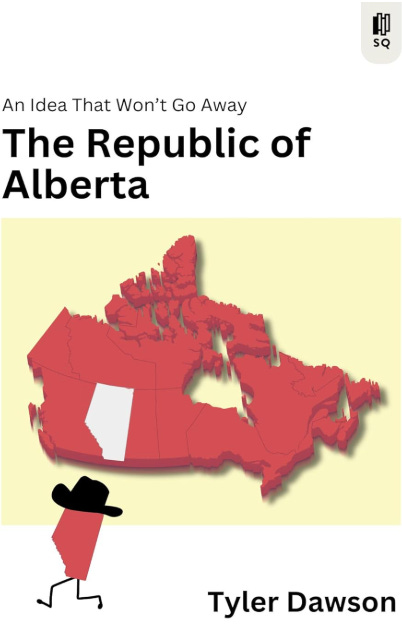
Coming soon from Sutherland Quarterly
Sutherland Quarterly is pleased to announce its latest edition, Tyler Dawson’s exceptionally timely The Republic of Alberta: An Idea that Won’t Go Away:
What could the consequences be if Alberta turned its back on Canada?
In The Republic of Alberta, Globe and Mail journalist Tyler Dawson delivers the definitive history and analysis of Alberta’s long-simmering separatist movement. From its colonial roots and early resentment toward Ottawa, through the oil-fuelled grievances of the NEP era, to the rise of modern populism and convoy protests, Dawson charts a clear trajectory of Western alienation. Blending historical insight with contemporary reporting, he examines the thinkers, politicians, and cultural flashpoints that have shaped the separatist impulse. As Alberta Premier Danielle Smith courts separatist sentiment more openly than her predecessors, Dawson explores the uncertain future of a province increasingly questioning its place in Canada.
Buy your copy now or take advantage of this special offer for SHuSH subscribers: buy a subscription to Sutherland Quarterly (or treat a friend) and we’ll send you the Sutherland House book of your choice at no charge.
Launched in 2022, Sutherland Quarterly is an exciting new series of captivating essays on current affairs by some of Canada’s finest writers, published individually as books and also available by annual subscription—four great books a year, mailed to your door, for just $67.99. Subscribe now at sutherlandquarterly.com and we’ll immediately be in touch to send you the free book of your choice.
Thanks for reading. Please either:
Our Newsletter Roll (suggestions welcome)
Adam McPhee’s Adam’s Notes, a public notebook of eclectic findings
Ian Coutts’ New Chapters, featuring new Canadian fiction
Banuta Rubess’s Funny, You Don’t Look Bookish, reviews five books a week.
The Bibliophile from Biblioasis, an independent publisher based in Windsor.
The Literary Review of Canada’s Bookworm, “your weekly dose of exclusive reviews, book excerpts, and more.”
Art Kavanagh’s Talk about books: Book discussion and criticism.
Gayla Gray’s SoNovelicious: Books, reading, writing, and bookstores.
Esoterica Magazine: Literature and popular culture.
Benjamin Errett’s Get Wit Quick, literature and other fun stuff
Lydia Perovic’s Long Play: literature and music.
Jason Logan’s Urban Color Report: adventures in ink (sign-up at bottom of page)
Anne Trubek’s Notes from a Small Press: like SHuSH, but different
Art Canada Institute: a reliable source of Canadian arts info/opinion
Kate McKean’s Agents & Books: an interesting angle on the literary world
Rebecca Eckler’s Re:Book: unpretentious recommendations
Anna Sproul Latimer’s How to Glow in the Dark: interesting advice
John Biggs Great Reads: strong recommendations
Steven Beattie’s That Shakespearean Rag, a newsy blog about books and reading
Mark Dykeman’s How About This: Atlantic Canadian interviews and thoughts on writing and creativity.
J. W. Ellenhall’s 3-Page Book Battles: Readers help her choose which of three random books to review each month.
Donald Brackett’s Embodied Meanings: “Arts music films literature and popular culture.”

I love your newsletter, and appreciate all the research that you put into it, but damn does it leave me frustrated, if not furious.
To see these stats in action, come to the Salon du livre de Montréal 2026 at the end of November.