

The hard thing about ordinary things
From "Desk Set" to dashboard

This is the 309th edition of SHuSH, the newsletter of The Sutherland House Inc. If you’re new here, press the button—it’s free:
Sutherland House is always happy to receive submissions of manuscripts or proposals for nonfiction books. If you are looking to get published, contact submissions@sutherlandhousebooks.com. Agents welcome, but no agent required.

A uniqely Canadian planner!
We noticed last year that virtually every planner available in the Canadian market has generic or American holidays and content, so we made a new one. Welcome to The Canadian Planner 2026!
Plan your days on the world’s only uniquely Canadian planner. Stay organized, informed, and Canadian every day of the year.
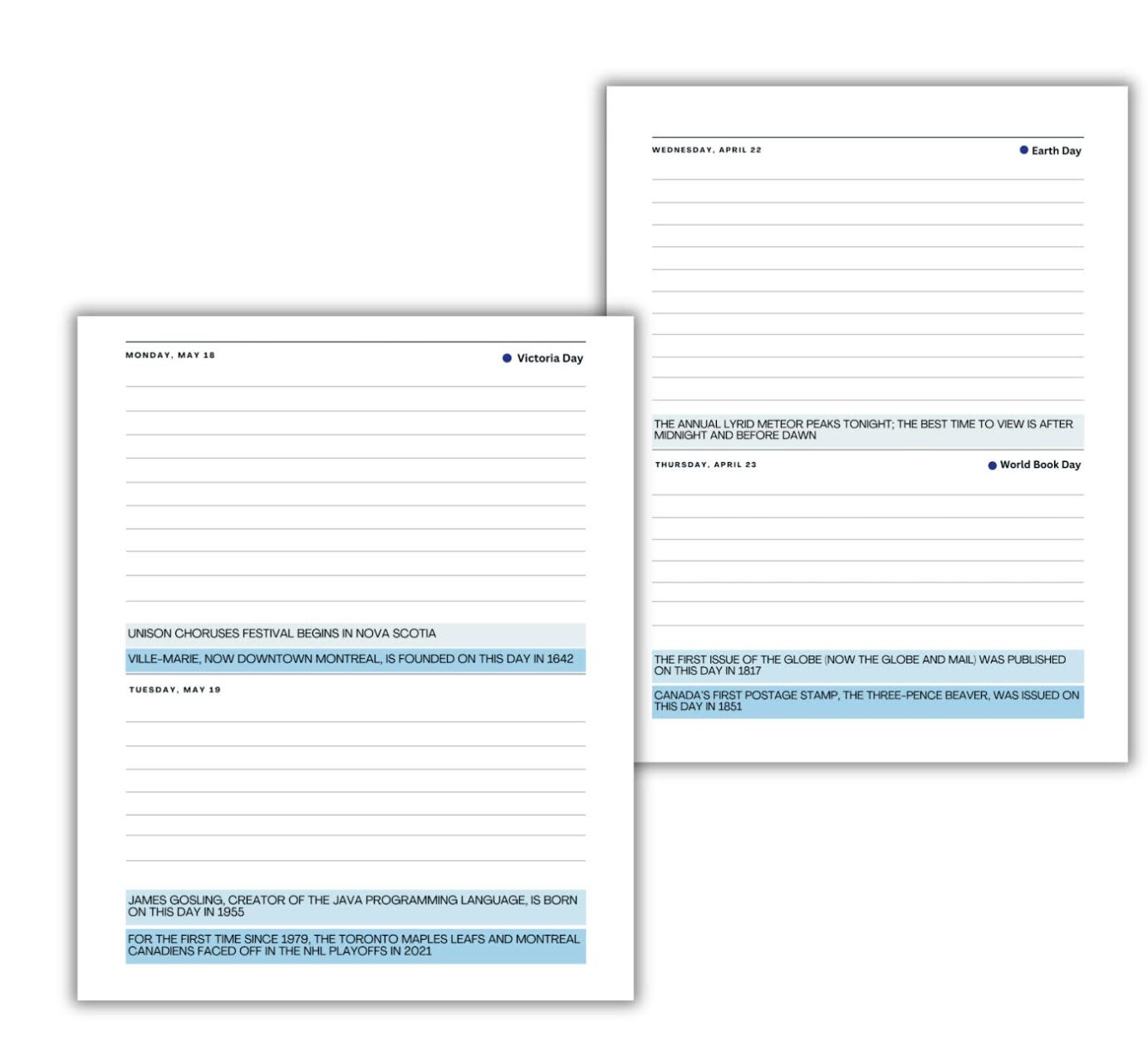
This elegant, thoughtfully designed planner is an indispensable companion for staying on top of your busy life and celebrating where you’re from. With two days per page, a clean layout, and generous space for appointments, notes, and to-dos, it keeps you focused and productive. Sprinkled throughout are:
key national observances
public holidays and civic observances
famous birthdays and historical notes
major arts, culture, and sports events
natural and astronomical occasions, weather highs and lows, and even bird migration and fruiting seasons.
Beautifully packaged in faux leather with silver foil accents and a ribbon marker, the Canadian Planner is the perfect way to stay organized and connected to all things Canadian.
It’s 6x9 inches, 224 pages, and available in blue or black and sells for just $19.95. Order one here! For bulk orders email timo@sutherlandhousebooks.com.
I spent two hours on a conference call with my accountant today and several hours more earlier in the week. We were trying to figure out what’s been happening on the apps and platforms on which our business is conducted.
One problem was at Amazon: was it collecting sales tax on books sold by some of our companies directly on Amazon, and, if so, was it remitting those taxes to the federal government or was I supposed to do that?
Another problem was tracing money coming into our bank account from a service called Stripe. It is the payment processor on our website, so all the money from book sales on our site flows through Stripe. It’s also the payment processor on Substack, meaning that money generated by SHuSH also flows through Stripe. And it’s the payment processor behind our Shopify account, so subscription revenues generated by Sutherland Quarterly flow through it, too. At the end of the month, we look at our bank statement and we can see Stripe money deposited here and Stripe money deposited there but it’s not at all clear which particular sales activity generated it. Accountants insist on attributing every cent of revenue to particular sales activities.
My first impulse, when frustrated by a service, is to contact the service and ask for help. My younger colleagues look for YouTube videos. Neither route brought relief. You can’t talk to anyone at Amazon or Stripe, and unless your particular problem is generic enough to make its long eye-glazing list of Frequently Asked Questions, you’re out of luck. Help videos aren’t strong on particulars, nor was Reddit. ChatGPT could tell us that Amazon should be remitting GST on our book sales, and it could confirm that both Substack and Shopify use Stripe to process payments, but it was of no further use in sorting out our problems.
When we weren’t speaking to our accountant about Amazon and Stripe, we were struggling to organize QuickBooks, our accounting software. QuickBooks is the preferred accounting platform of many accountants, including ours. I’m an Apple person. I find Apple intuitive. I find Microsoft products less so, and QuickBooks miles behind Microsoft.
I won’t bore you (further) with the details, but we were trying to figure out how to keep all our expenses in meaningful categories on QuickBooks while also attributing them to particular books. It doesn’t much matter to me that every dollar we spend is attributable to a particular book. Our granting agencies feel differently. They insist on it, even if it costs us weeks of work to figure it out. So we’re now trying to formulate a system of record keeping that gives us the perspective we want on our business while simultaneously organizing it for grant applications. The granting agencies insist on all kinds of time-consuming reporting and expensive auditing that gravely undermines the effectiveness of their programs. And each grant program has its own portal, with its own distinct rules, some of which reflect standardized accounting practices, some of which don’t. Sometimes the people behind the programs are hugely helpful, sometimes they’re not. Our accountant bailed on us at 4 p.m. this afternoon, unable to think anymore. I was relieved she finally gave up, because I’d checked out at 3:30.
Also this week, we spent hours on calls with our royalty software provider. Authors are paid royalties on book sales, usually ten percent of the cover price for each book sold. But there are many exceptions. The royalty might sometimes be a little higher, sometimes a little lower, depending on where the book is sold, whether it’s hardcover, softcover, an e-book or audiobook, whether it’s heavily discounted, etc. Things get hideously complex.
The Fitzhenry & Whiteside companies we bought this year were on another, older royalty software. Each of the four companies, at one point or another, appears to have a different royalty strategy, meaning different rules among the companies, and sometimes different rules within the companies depending on when the contracts were written. You might think that in an age when AI can write software, it ought to be rather easy to transfer your royalty data from one provider to another without tearing your hair out. You should be able to simply download all the royalty points onto a spreadsheet and upload them onto the new system. But you can’t. The systems don’t talk to each other. It is up to the new system to interpret what was happening on the old system, and it’s not built to interpret anything. It just wants you to give it clean data so it can spit out royalty statements.

Gift a tote to your favourite reader!
Just in time for Christmas, we’ve got a new batch of Sutherland House’s first ever tote bag. It’s fine heavy canvas, and it’s got a bottle holder inside. Dimensions are 39x36x12 cm. It sells to SHuSH readers for $15. To order, email Timo@sutherlandhousebooks.com.
The companies that distribute our books also have proprietary online interfaces. At their best, these let you see how many books you have in inventory and how many books have been ordered. They also distribute information about each book, known as metadata, to retailers who use the information to present the book to the reading public. All the listings you see on Amazon, Barnes & Noble, and Indigo are based on metadata.
We moved from one US distributor to another in October. They have separate and incompatible web portals, so when you move you wind up rebuilding your presence on the new portal almost from scratch. We spent more time this week trying to figure out why there were 40,000 fewer books in our warehouses than our accounting statements said we possessed, based on how many we’d printed and sold. An additional chunk of time was wasted checking every e-book in our catalog to see if it was available on every available retail platform, because some were missing—the metadata was stuck.
I left work last night feeling as though I worked for my digital tools, systems, portals, and platforms, rather than they worked for me. I made a long list of them: the platforms and portals of Amazon, our distributors, the bank, the granting agencies, the post office, our wireless and internet providers; our payment solutions (Stripe, WooCommerce, Square); our metadata provider; audiobook platform; our so-called office solutions (Google Workspace and Microsoft 365); our website platforms (WordPress and some custom mess); our marketing services (Cision, BookBub, Edelweiss, Mailchimp, etc.); various design and editing software (Word, Adobe, Canva); cloud storage, WeTransfer and Dropbox; the digital services you need for ISBNs and copyright. There are more. I’m going to put them all in a bracket and make them compete for worst digital experience.
They are all advertised as solutions—things that are supposed to make your life easier. Everyday experience, dealing with banks, telcos, airlines, tells us that’s not true. They are ingeniously designed to offload the provider’s labour to you. The only difference between the individual and small business experience is that the latter deals with so many more of these services and tools, and they have all the power. They’re optimized to benefit their owners, not their end users. They’re concerned with easing their workflow. They’re built to accommodate their scale. They accumulate the data they want and minimize their risks. They are intolerant of exceptions. They are careless of your time. There is no goodwill, flexibility, reciprocation. They are asocial as fuck.
I’ve tried to write this without sounding like a grumpy old man, but I do remember rather fondly a time when service providers at least pretended to feel an obligation to assist their customers. It seems my younger colleagues, having never known anything but remote and indifferent web-based interactions, are more easily reconciled to them. It’s their normal. And it inevitably becomes our normal. We use all these tools and services and become more difficult to interact with ourselves.
I don’t have a point here. I’m just whinging. Maybe I understand better why so many people and businesses, as they age, stick to the tools and services they know and don’t bother to upgrade. I think it is necessary to keep up, but it’s exhausting.
Funny thing, I watched Desk Set last weekend, the 1957 workplace comedy starring Katherine Hepburn and Spencer Tracy. The plot revolves around the introduction of a supposedly labour-saving IBM computer into the offices of a media company at Christmastime. It’s an uncannily relevant parable for the themes above: the illusion of the “solutions” offered by digital technology; the enormous gap between their fantastic promises and operational reality; the limits of technology’s ability to appreciate nuance and exercise judgment; how technology doesn’t so much replace workers as subordinate them and diminish their dignity. I enjoyed it as a film. I should have taken it as a warning.
Give A Thoughtful Gift
As a SHuSH subscriber, you are eligible for this spectacular holiday offer: buy a gift subscription to Sutherland Quarterly (or treat yourself) and we’ll send you the Sutherland House book of your choice at no charge.

Launched in 2022, Sutherland Quarterly is an exciting new series of captivating essays on current affairs by some of Canada’s finest writers, published individually as books and also available by annual subscription—four great books a year, mailed to your door, for just $67.99. Subscribe now at sutherlandquarterly.com and we’ll immediately be in touch to send you the free book of your choice.
Sutherland Quarterly is also pleased to announce its latest edition. Sign up now and begin your subscriptions with Mark Leiren-Young’s Greener Than Thou:

A hilarious romp through the past, present, and future of Green politics in Canada.
Mark Leiren-Young, a lifelong environmentalist and Leacock Medal-winning humour writer, journeys to the heart of greenness to reveal the toxic sludge of Canadian eco-politics.
For a brief moment in 2019, it looked like Elizabeth May’s Green wave could change Canadian politics and finally wield real power in Ottawa. During that brief moment, Leiren-Young was a campaign manager in a riding the federal Greens were sure to win. He quit on discovering that there was only one thing stopping the Green Party of Canada from changing the country’s electoral landscape forever: the Green Party of Canada.
The Greens were not ready for prime time. Or late night. Or four a.m., after last call, when voters stop being picky and are desperate for anyone with a nice smile. Once the spotlight hit, the Greens wilted, never to recover.
A comedic take on the sorry state of Canada’s environmental politics, Greener Than Thou explores how the Green party has repeatedly shot itself in the foot, blasted out its kneecaps, and done everything in its power to ensure it will never have a say in decisions that shape the future of our planet.
Thanks for reading. Please either:
Our Newsletter Roll (suggestions welcome)
Banuta Rubess’s Funny, You Don’t Look Bookish, reviews five books a week.
The Bibliophile from Biblioasis, an independent publisher based in Windsor.
The Literary Review of Canada’s Bookworm, “your weekly dose of exclusive reviews, book excerpts, and more.”
Art Kavanagh’s Talk about books: Book discussion and criticism.
Gayla Gray’s SoNovelicious: Books, reading, writing, and bookstores.
Esoterica Magazine: Literature and popular culture.
Benjamin Errett’s Get Wit Quick, literature and other fun stuff
Lydia Perovic’s Long Play: literature and music.
Jason Logan’s Urban Color Report: adventures in ink (sign-up at bottom of page)
Anne Trubek’s Notes from a Small Press: like SHuSH, but different
Art Canada Institute: a reliable source of Canadian arts info/opinion
Kate McKean’s Agents & Books: an interesting angle on the literary world
Rebecca Eckler’s Re:Book: unpretentious recommendations
Anna Sproul Latimer’s How to Glow in the Dark: interesting advice
John Biggs Great Reads: strong recommendations
Steven Beattie’s That Shakespearean Rag, a newsy blog about books and reading
Mark Dykeman’s How About This: Atlantic Canadian interviews and thoughts on writing and creativity.
J. W. Ellenhall’s 3-Page Book Battles: Readers help her choose which of three random books to review each month.
Donald Brackett’s Embodied Meanings: “Arts music films literature and popular culture.”

Great post, Grumpy Old Man! :)
I'm actually coming across more and more people who are fed up with various aspects of online culture. Proprietary systems that don't play nice with each other are the worst. As is Meta. I've got Cory Doctorow's Enshittification in my TBR pile. I think I'll move it to the top of the list.
What we need is a mass consumer protest against companies who use online programs to deal with customer questions and complaints. There is no such thing as customer service anymore. It’s on the customer to handle the problems and doing so can take hours out of your day. Oh, for the era when you could phone one of these companies to ask for help and a friendly human voice answered
.