

What to expect when you're expecting book sales
This is the 324th edition of SHuSH, the newsletter of The Sutherland House Inc. If you’re new here, press the button—it’s free:
Sutherland House is always happy to receive submissions of manuscripts or proposals for nonfiction books. If you are looking to get published, contact submissions@sutherlandhousebooks.com. Agents welcome, but no agent required.
I find expectations one of the most difficult things to manage in book publishing.
That includes our own expectations, as publishers, when we release a book. Before we know much about what readers will think of it, we have to determine a new title’s print run. Usually we’re guessing. We can look at how similar books have sold, we can study our pre-order patterns, we can talk to our sales team, and our sales team can talk to retailers, but at the end of the day we’re throwing darts.
I spoke to a large publisher last summer, one who uses all kinds of sophisticated formulae to assess print runs, and he said his executives had just completed an analysis that showed their initial orders of books, across all genres and through many seasons, averaged 20 percent higher than necessary. We do about the same, without the formulae.
I think most publishers err on the side of over ordering. We’re all optimists by nature. We tend to fall in love with our own books. The economics of print runs tempt you to order generously: the more you buy, the lower the cost per copy.
We’re also aware of the pain that comes with under-estimating demand. No one wants to be caught short of stock if a book comes out of the gate strong. Being unable to fulfil orders is bad for business, and it leads to difficult conversations with the author, even if it’s good news in the sense that there’s demand for the book. So estimates tend to be high.
Author expectations are similarly difficult. More difficult, in fact. While some writers are happy to be published and grateful for their readers, even if those readers, in aggregate, wouldn’t fill a concert hall, others aspire to move inventory by the pallet. They have their eyes on bestseller lists.
It’s entirely understandable. Books are an incredible amount of work. Authors invest their whole selves in them. They don’t do that unless they have a strong conviction that their book needs to be written and deserves to be read. Publishers know this, and share the author’s conviction (hence the large press runs). They do all they know how to do, and all they can afford to do, to meet authorial expectations. On occasion, they succeed. Most often they don’t. It’s a recipe for mass heartbreak.
The best guide to reasonable expectations for book sales in North America emerged several years ago from the Department of Justice versus Penguin Random House antitrust trial. An astonishing trove of information came out of that case. If I ran the Author’s Guild, I’d be lobbying congress to make it mandatory for the DOJ to sue one of the Big Five every few years so the rest of us can keep up with how the business really works.
Anyway, a reporter covering DOJ versus PRH quoted a lawyer as telling the court that of the 58,000 books published annually by the Big Five houses, 90 percent sell fewer than 2,000 copies. If that wasn’t shocking enough, the lawyer also said that half of the 58,000 “sell fewer than one dozen books.”
The latter stat went viral. A series of knowledgeable commentaries on book sales challenged it, and it appears to have been incorrect. The reality, however, is scarcely more consoling. Kristen McLean, an analyst for BookScan, the most authoritative of the generally unauthoritative sources of book data available to the trade, studied a year’s worth of newly released physical books by America’s ten largest publishers, 45,571 ISBNs in all. Her findings, courtesy of Jane Friedman’s newsletter, were as follows:
0.4% or 163 books sold 100,000 copies or more
0.7% or 320 books sold between 50,000–99,999 copies
2.2% or 1,015 books sold between 20,000–49,999 copies
3.4% or 1,572 books sold between 10,000–19,999 copies
5.5% or 2,518 books sold between 5,000–9,999 copies
21.6% or 9,863 books sold between 1,000–4,999 copies
51.4% or 23,419 sold between 12–999 copies
14.7% or 6,701 books sold under 12 copies.
There are a whole bunch of qualifiers to those stats. They represent one year of sales, not lifetime sales, and they are limited to the US, so foreign sales not included. They count bookstore sales, not audiobook or ebook sales or Audible listens. They don’t include books sold directly by the author or the publisher, or books sold outside the usual bookstore channels (gift shops, for instance).
The qualifiers are important.
Some books take a year or more to find their audience and take off. Madeline Miller’s The Song of Achilles had a respectable literary release in 2011, winning the Orange Prize, but it wasn’t a commercial juggernaut until BookTok discovered it almost a decade later. Yuval Noah Harari’s Sapiens was published in Hebrew in 2011 and in English three years later. Its peak sales years were roughly from 2017 to 2021.
Other books find the bulk of their audience outside the channels tracked by BookScan. Late last year, the Wall Street Journal reported that the audio edition of Karin Slaughter’s thriller We Are All Guilty Here was outselling the bestselling hardcover edition. Celebrity memoirs, including Brooke Shields’s Brooke Shields is Not Allowed to Get Old, can see similar results.
Independent publishers can be very effective at direct-to-consumer sales—events, targeted campaigns, website sales, bulk sales—that don’t show up in a BookScan survey. These channels can produce double or triple the unit sales of bookstores for their books.
At the end of the day, however, those BookScan numbers are directionally sound. Most books do most of their sales in year one, and most sell primarily through bookstores in physical formats. If the numbers above—showing that two-thirds of books sell less than 1,000 copies—represent an undercount, a better guess is likely that two-thirds of books sell in the range of 1,200 to 1,500 copies.
For author and publisher both, the publication of any book is the triumph of hope over data.
It’s important, then, to have achievable goals and reasonable expectations at the start of a publishing project. A writer grateful for 1,500 or 2,000 readers will find the whole adventure far more satisfying than someone who sold 5,000 and expected 20,000.
It’s more important for authors to take sales as one factor among many in a book’s success. Are you happy with your work? How it reads? Does it say what you want it to say? Will the audience for which the work was intended find meaning in it? Does the book contribute to a debate, reshape how some person or issue is viewed?
An excellent book that sells in three figures can alter the trajectory of an author’s career and win important prizes.
One great review, even one heartfelt response from a reader, can mean far more than a royalty cheque.
It’s the same from the publisher’s perspective. All publishers are grateful for their bestsellers, but all of them can also tell you, with equal enthusiasm, about a great experience with an author who didn’t sell much but wrote a fantastic book and was a joy to work with. And they’ll work with those authors again and again, even if the results are less than stellar.
Coming soon from Sutherland Quarterly
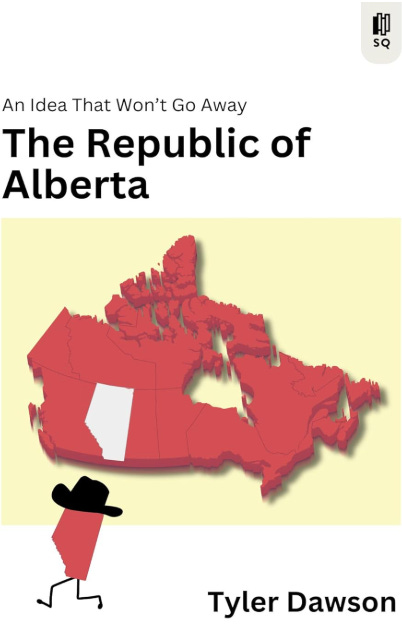
Sutherland Quarterly is pleased to announce its latest edition, Tyler Dawson’s exceptionally timely The Republic of Alberta: An Idea that Won’t Go Away:
What could the consequences be if Alberta turned its back on Canada?
In The Republic of Alberta, Globe and Mail journalist Tyler Dawson delivers the definitive history and analysis of Alberta’s long-simmering separatist movement. From its colonial roots and early resentment toward Ottawa, through the oil-fuelled grievances of the NEP era, to the rise of modern populism and convoy protests, Dawson charts a clear trajectory of Western alienation. Blending historical insight with contemporary reporting, he examines the thinkers, politicians, and cultural flashpoints that have shaped the separatist impulse. As Alberta Premier Danielle Smith courts separatist sentiment more openly than her predecessors, Dawson explores the uncertain future of a province increasingly questioning its place in Canada.
Buy your copy now or take advantage of this special offer for SHuSH subscribers: buy a subscription to Sutherland Quarterly (or treat a friend) and we’ll send you the Sutherland House book of your choice at no charge.
Launched in 2022, Sutherland Quarterly is an exciting new series of captivating essays on current affairs by some of Canada’s finest writers, published individually as books and also available by annual subscription—four great books a year, mailed to your door, for just $67.99. Subscribe now at sutherlandquarterly.com and we’ll immediately be in touch to send you the free book of your choice.
Thanks for reading. Please either:
Our Newsletter Roll (suggestions welcome)
Ian Coutts’ New Chapters, featuring new Canadian fiction
Banuta Rubess’s Funny, You Don’t Look Bookish, reviews five books a week.
The Bibliophile from Biblioasis, an independent publisher based in Windsor.
The Literary Review of Canada’s Bookworm, “your weekly dose of exclusive reviews, book excerpts, and more.”
Art Kavanagh’s Talk about books: Book discussion and criticism.
Gayla Gray’s SoNovelicious: Books, reading, writing, and bookstores.
Esoterica Magazine: Literature and popular culture.
Benjamin Errett’s Get Wit Quick, literature and other fun stuff
Lydia Perovic’s Long Play: literature and music.
Jason Logan’s Urban Color Report: adventures in ink (sign-up at bottom of page)
Anne Trubek’s Notes from a Small Press: like SHuSH, but different
Art Canada Institute: a reliable source of Canadian arts info/opinion
Kate McKean’s Agents & Books: an interesting angle on the literary world
Rebecca Eckler’s Re:Book: unpretentious recommendations
Anna Sproul Latimer’s How to Glow in the Dark: interesting advice
John Biggs Great Reads: strong recommendations
Steven Beattie’s That Shakespearean Rag, a newsy blog about books and reading
Mark Dykeman’s How About This: Atlantic Canadian interviews and thoughts on writing and creativity.
J. W. Ellenhall’s 3-Page Book Battles: Readers help her choose which of three random books to review each month.
Donald Brackett’s Embodied Meanings: “Arts music films literature and popular culture.”

First, Sir, I am currently reading Tyler Dawson's piece for the latest SQ. So far, so good.
Now to more substance.
Very interesting column, to be sure - but then I say that about ALL of your columns; you should take up writing as a career!
I found this particular aspect of the publishing biz to be, well, fascinating, interesting - all the adjectives. Quite frankly, I was left with a few thoughts that won't go away.
I have been aware for many years that publishing in Canada was pretty much a hand to mouth business. Nay, for many it seems to be a labor of love, a hobby, for I question the appellation of business when it seems that profit is so distant an objective.
Carrying that thought forward, one wonders if you would recommend the publishing industry to one of your offspring. I have my suspicions but, then, I suppose it would depend if that offspring was independently wealthy.
[Old joke: Two old farmers get talking and F1 asks F2 what he would do if he won the lottery. F2 responds that he would keep farming until the money was all gone. Might we substitute publishers in place of farmers?]
I suspect that the development of SQ is, as much as anything else, a way to get names on a mailing list and, with the subscriptions, a guaranteed sale. Sounds pretty wise to me.
Excellent column! Writers are driven by passion (compulsion). If they are lucky to have sufficient money, time, and health, they can create/produce. Are publishers driven by the same, or slightly different factors?